
The 9 steps of the project management journey (p1)
An Experienced Approach to Deliver Great
Greenfield and Brownfield Projects
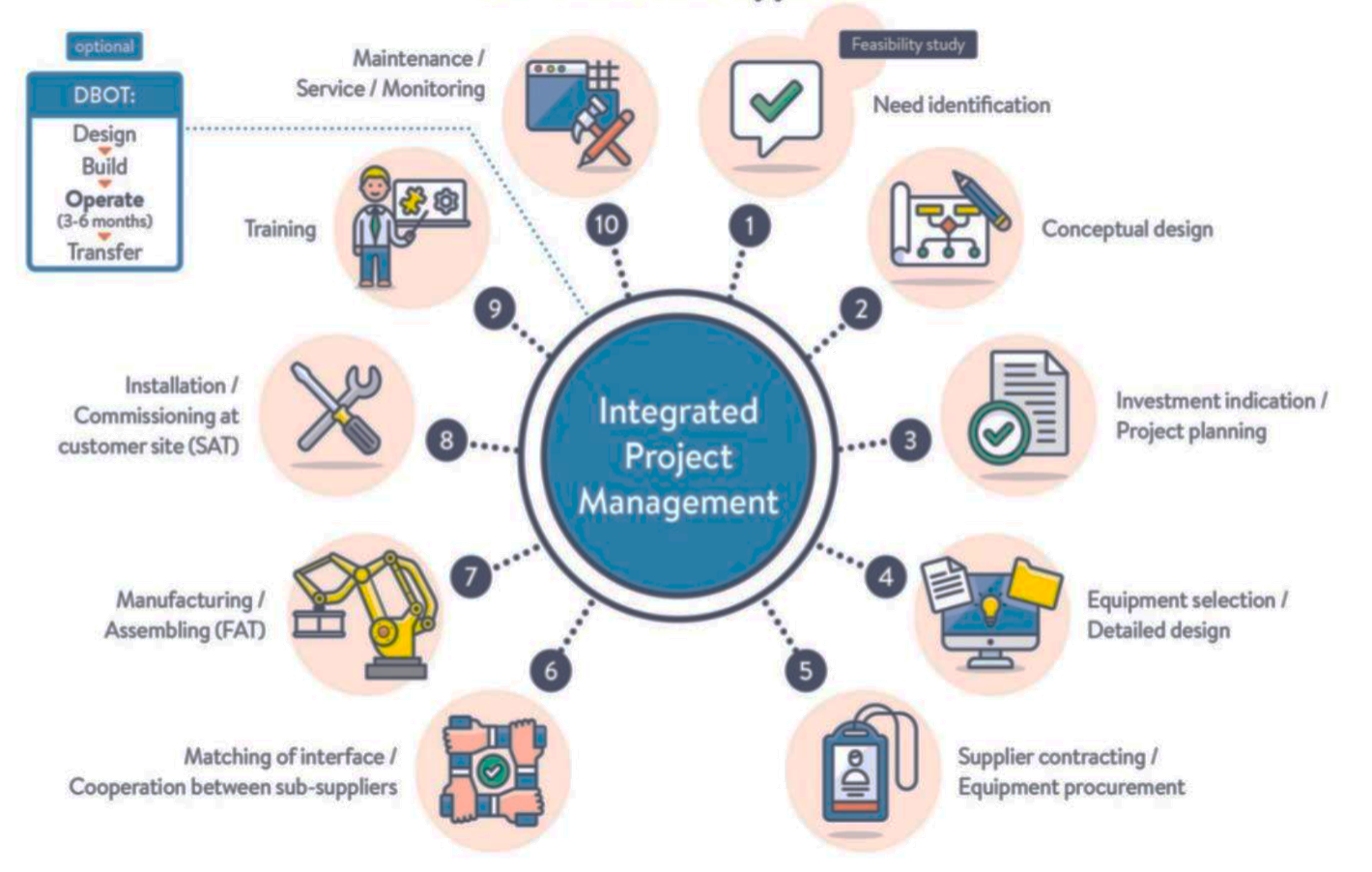
1. Need Identification (LoR)
From ambition to engineering clarity
Every successful project starts with the right questions.
In the Need Identification phase, we translate your strategic ambition into concrete technical and economic parameters. What product are we making? What volumes are required? What quality level must be achieved? What regulatory framework applies? What are the sustainability targets and scalability ambitions?
We combine market understanding with process engineering logic. Using our proprietary Software Suites, we access structured databases on ingredients, product characteristics, microbiological constraints, and processing requirements. This allows us to define realistic production targets from day one.
The outcome is not a vague brief, but a technically grounded starting point for design. This is the List of Requirements (LoR) document, crucial to have and crucial to have a full agreement about this LoR.
2. Conceptual Process Design
Rapid pre-engineering with FlowBite
Once the need is clearly defined, we move into Conceptual Design — where ideas become structured process flows.
Using FlowBite, our digital process engineering environment, we rapidly build preliminary process diagrams, mass balances, line configurations, and capacity models. Instead of weeks of manual spreadsheet work, we develop consistent pre-design scenarios within days.
FlowBite enables:
Quick comparison of processing routes
Early-stage sizing of core equipment
Yield and energy estimations
Process logic validation
Behind this digital speed stands our deep engineering expertise and decades of accumulated data. Conceptual design becomes faster, clearer, and significantly more reliable.
The result: a technically coherent pre-design ready for CAPEX modelling and financial validation including OPEX.
3. Investment Indication
Transparent CAPEX & OPEX modeling
A concept only becomes valuable when its financial implications are clear.
In this phase, we translate the conceptual design into a structured investment indication. We combine process calculations from FlowBite with our extensive databases covering:
CAPEX benchmarks
Machine price libraries (internal databases).
Projectmanagement and Installation cost ratios
Utility and energy consumption models
Labor structures estimation
Basic maintenance assumptions
This enables early but realistic CAPEX and OPEX calculations. Sensitivities can be analyzed, alternative configurations compared, and scaling effects evaluated.
Because engineering logic and cost data are fully integrated, assumptions remain transparent and traceable. Clients gain a reliable investment bandwidth before entering detailed engineering or supplier negotiations. Your CFO can check and double-check the P&L with confidence. All financial projections are built on validated process models, structured CAPEX databases, and realistic operational assumptions.
4. Supplier and Equipment Selection
From functional requirement to technical specification
With technical and financial feasibility established, we proceed to Equipment Selection.
At this stage, we translate the conceptual process design into functional equipment specifications. Rather than starting with brands or quotes, we start with performance requirements like: capacity, thermal load, hygienic design level, automation needs, cleaning regimes, and integration complexity.
Our Software Suites provide access to detailed equipment performance data, processing constraints, and food safety validation parameters. This ensures that equipment selection is not based on brochures — but on engineering fundamentals. Where needed, we benchmark suppliers against performance criteria and budget targets, ensuring alignment between technical ambition and financial reality.
Importantly, we do not sell machines. We provide independent engineering services. This means our advice, designs, and calculations are fully objective and exclusively focused on your best interests. You can expect our work to meet the highest professional standards, both technically and commercially.
We carefully review quotations from potential machine builders for technical applicability, process integration, and long-term operational robustness. In addition, we assess contractual and legal correctness, ensuring that specifications, performance guarantees, and responsibilities are clearly defined.
All supplier quotations are benchmarked using third-party references, market data, and our own extensive cost and performance databases. This enables us to identify inconsistencies, validate price levels, and strengthen your negotiating position.
The result is not simply a comparison of offers — but a structured, transparent evaluation that safeguards both technical performance and financial integrity.
The result is a robust, well-defined equipment shortlist — ready for detailed design and supplier contracting.
