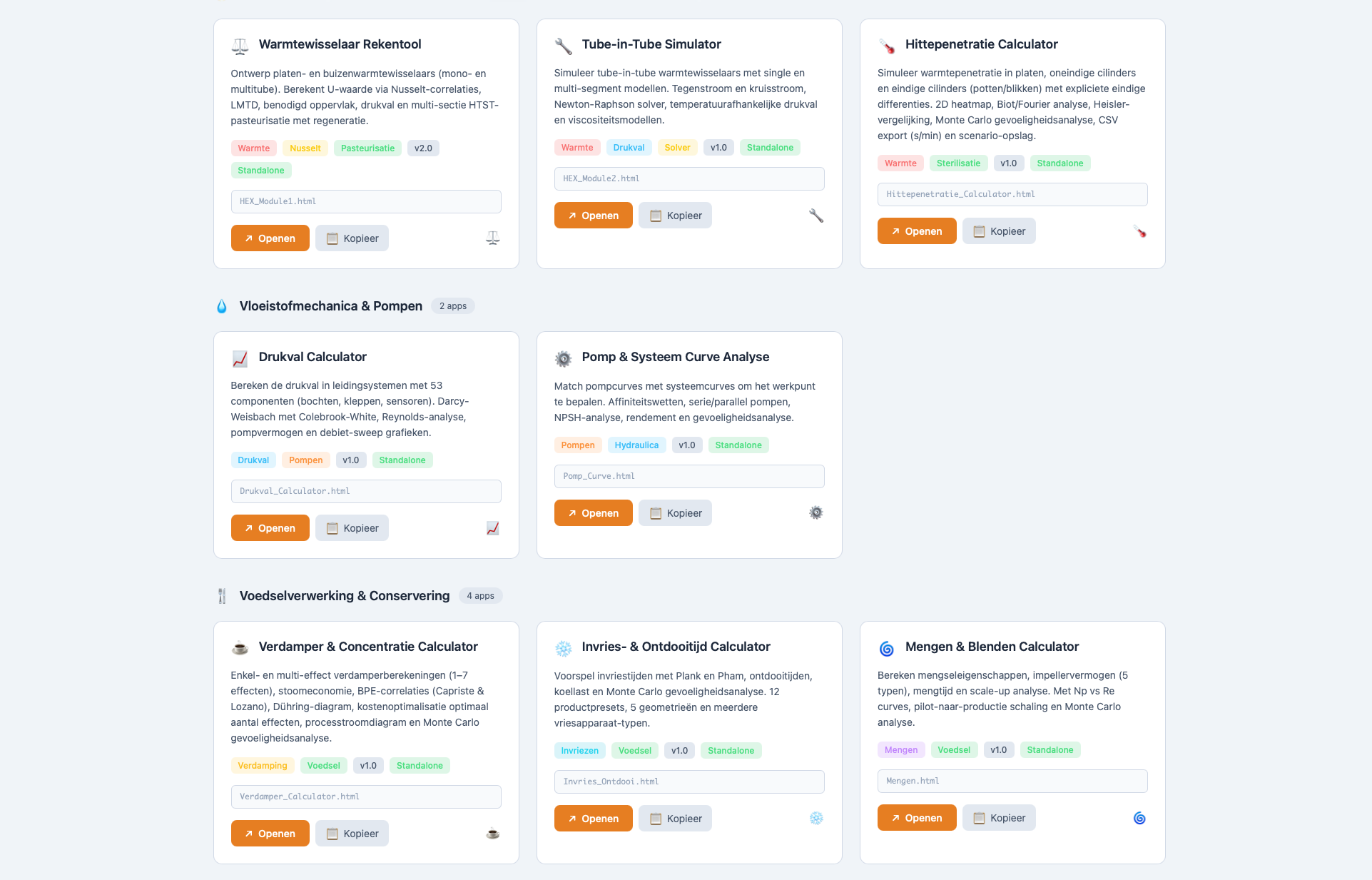
The Processing Suite
Engineering Intelligence for Modern Food Processing
The Processing Suite is a comprehensive collection of advanced engineering tools designed specifically for food technologists, process engineers, R&D specialists, and technical managers. It brings together scientific rigor, practical usability, and interactive simulation in one integrated environment.
In food processing, decisions about heat transfer, drying, freezing, pumping, evaporation, and formulation directly affect safety, quality, energy efficiency, and profitability. Yet many calculations are still performed in spreadsheets, fragmented software packages, or outdated reference tables. The Processing Suite replaces this fragmented approach with a scientifically validated, modular platform built around real process engineering models.
At its core, the Suite is based on established physical principles — heat transfer theory, fluid dynamics, thermodynamics, diffusion models, and validated food property correlations. It is not a black-box calculator. Each module is transparent, traceable, and grounded in widely accepted engineering equations.
Scientifically Grounded Modules
The Suite includes advanced tools for:
Plate and tubular heat exchanger design
Dynamic tube-in-tube simulations
Pressure drop and fluid flow analysis
Pump and system curve matching
Freezing and thawing time prediction
Drying kinetics modeling and diffusivity analysis
Evaporator and multi-effect concentration design
Heat penetration simulation with Biot and Fourier analysis
Ingredient blending and thermophysical property estimation
Direct access to validated food property databases
Thermophysical properties are calculated using internationally recognized models such as Choi & Okos correlations, while drying modules incorporate widely used thin-layer models like Page, Weibull, and Midilli-Kucuk. Heat transfer modules apply established Nusselt correlations including Dittus–Boelter and Sieder–Tate.
This ensures engineering credibility at every level.
Designed for the Food Industry
Unlike generic engineering software, The Processing Suite is built specifically for food applications. It understands the realities of milk pasteurization, fruit juice sterilization, vegetable freezing, sauce concentration, spray drying, and thermal validation for canned products.
From dairy to beverages, from plant-based alternatives to infant nutrition, the Suite supports real industrial use cases.
Visual, Interactive, Insightful
Complex physics becomes intuitive through interactive visualizations:
Temperature–time graphs
Position–time heat maps
Pump and system curve overlays
Energy balance breakdowns
Drying curve fits with statistical validation
Monte Carlo sensitivity distributions
Engineers can immediately see how variations in flow rate, temperature, geometry, or composition affect performance.
Built for Engineers Who Want to Understand
The Processing Suite empowers professionals who do not want approximations — but insight.
It bridges theory and practice.
It transforms equations into decisions.
It turns process complexity into engineering intelligence.
Whether you are optimizing an existing factory or designing the next generation of food processing technology, The Processing Suite gives you the tools to engineer with precision.
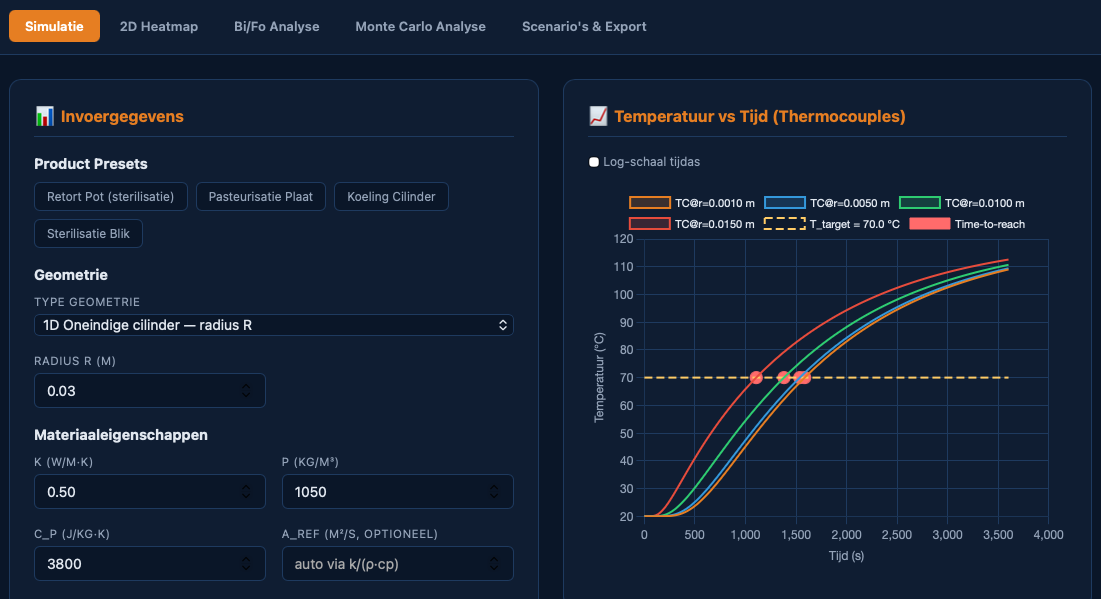
Heat Penetration Calculator
Ensure food safety with accurate heat penetration simulations. Validate your sterilisation and pasteurisation processes with this advanced thermal simulator. The tool uses an explicit finite difference solver to calculate heat conduction in three geometries: infinite slab, infinite cylinder and finite cylinder (can or jar).
Place virtual thermocouples at any desired location and track the temperature evolution over time. The interactive 2D heatmap with time slider provides unique visual insight into the temperature distribution within your product.
Analyse the process using dimensionless numbers (Biot and Fourier) for regime identification. Run a lightning-fast Monte Carlo analysis thanks to the optimised analytical Heisler solver. Save scenarios and export data to CSV with the time axis in seconds or minutes — temperature always in degrees Celsius. Indispensable for process validation, F₀-value calculations and demonstrating food safety during audits and certifications.
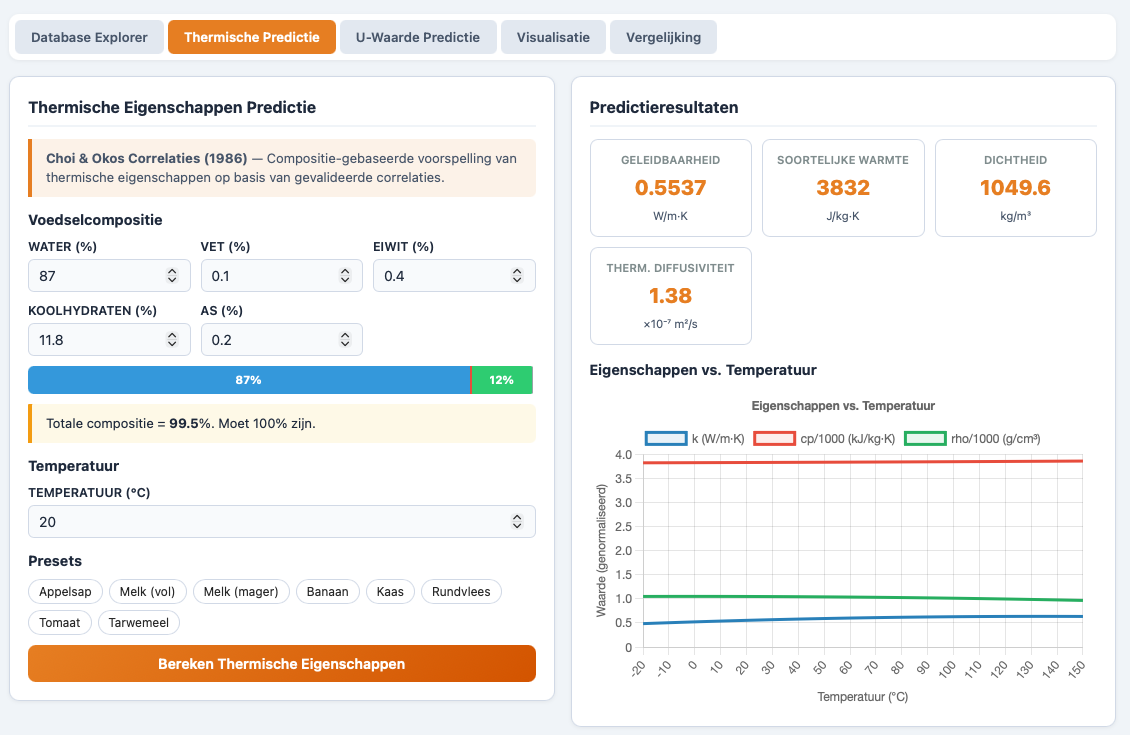
Food Properties Database
Instant access to crucial thermal properties of food products. No more time-consuming searches through textbooks and journal articles. This database offers a fast, clear interface to look up the thermal properties of hundreds of food products. The data is based on the internationally renowned models of Choi & Okos (1986), calculating density, specific heat capacity, thermal conductivity and thermal diffusivity from the proximate composition: moisture, protein, fat, carbohydrates, fibre and ash.
Enter a temperature and instantly receive the properties you need for heat transfer calculations, process design or simulations. The tool also includes a comprehensive reference table of typical heat transfer coefficients (h-values) for various processes such as boiling, pasteurisation, cooling, freezing and drying. Search by product name or category and export results for use in your own calculations.
Your starting point for every thermal process design.
The Processing Suite – Module Overview
1. Heat Exchanger Design Tool (PHE & THE)
Design and analyze plate and tubular heat exchangers with accurate calculations of U-value, LMTD, required heat transfer area, and pressure drop. The module allows engineers to model full HTST systems including regeneration and cooling sections, supporting optimization of thermal processes in dairy, beverages, and prepared foods.
2. Tube-in-Tube Dynamic Simulator
Simulate the transient startup behavior of tubular heat exchangers from cold start to steady state. This tool provides detailed temperature evolution along the tube over time, helping validate control strategies and determine accurate startup and holding times.
3. Pressure Drop Calculator
Calculate pressure losses across pipes, bends, valves, and fittings using the Darcy–Weisbach equation and advanced friction factor correlations. Engineers can optimize piping design, reduce pump energy consumption, and prevent costly oversizing or operational inefficiencies.
4. Pump & System Curve Analysis
Match pump performance curves with system resistance curves to determine the true operating point. The module also evaluates shaft power, efficiency, speed variation effects, and NPSHa to prevent cavitation and ensure reliable pump selection.
5. Freezing & Thawing Calculator
Predict freezing and thawing times for slabs, cylinders, and spheres using validated Plank and Nagaoka models. This module supports cold chain optimization, capacity planning, and quality assurance for frozen food production.
6. Mixing & Blending Calculator
Calculate the resulting composition and thermophysical properties of ingredient mixtures based on weighted proportions. The tool supports formulation development by instantly showing how changes in composition affect density, heat capacity, conductivity, and overall product behavior.
7. Drying Process Analyzer
Model drying kinetics using established thin-layer models and determine effective moisture diffusivity and activation energy. Engineers can design dryers, estimate energy consumption, and perform sensitivity analyses to optimize drying efficiency and product quality.
8. USDA Food Explorer
Access detailed compositional and nutritional data for hundreds of food products within an integrated searchable database. The module also calculates temperature-dependent thermophysical properties, supporting rapid product comparison and process design calculations.
9. Evaporator & Concentration Calculator
Design single- and multi-effect evaporators with full mass and energy balances, steam economy calculations, and boiling point elevation corrections. The tool enables optimization of concentration processes in dairy, juice, sugar, and sauce applications.
10. Heat Penetration Simulator
Simulate conductive heat transfer inside canned or packaged foods using finite difference or analytical solutions. Engineers can evaluate temperature distribution, Biot and Fourier numbers, and validate sterilization processes to meet food safety standards.
11. Food Properties Database
Quickly retrieve temperature-dependent thermophysical properties based on validated Choi & Okos correlations. This database supports all thermal calculations within the Suite and serves as a reliable starting point for process modeling and equipment design.